
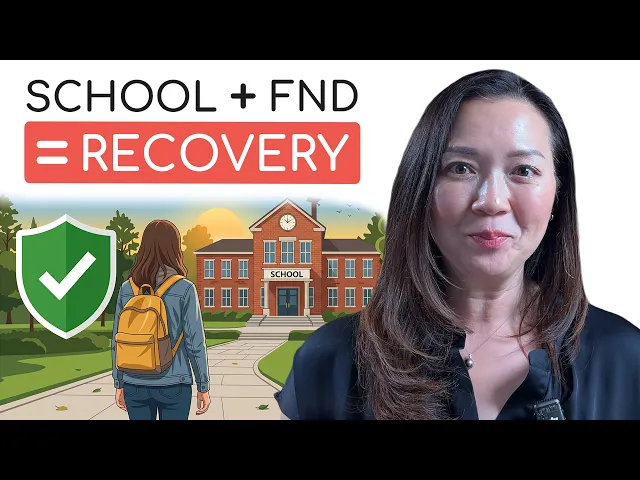
FND Recovery Includes Going to School — Here's Why

Dr. Jin Lee, PsyD
If the week before school starts has you replaying the same scene — your teen collapsing in the hallway, classmates staring, a teacher calling 911 — you’re not alone. Many parents of teens with Functional Neurological Disorder wrestle with the question of whether the safer choice is to keep their child home a little longer.
But what if the research and hundreds of clinical cases point in the opposite direction?
Dr. Jin Lee, pediatric psychologist and founder of Teen FND Academy, breaks down why school is not the reward waiting at the end of recovery — it’s part of what makes recovery happen. She walks through what a realistic, gradual return to school actually looks like, what to do when the school isn’t cooperating, and how to tell the difference between a genuine need for a hybrid schedule and parent anxiety driving the decision.
Key Takeaways
Keeping your teen home to protect them can actually reinforce the FND stuck loop rather than help them recover.
Peer-reviewed research shows that school participation is built into the most successful FND treatment programs — it’s part of the plan, not the reward
A realistic return to school starts with finding one easy entry point and building from there with small, repeated wins
When schools aren’t cooperating, parents can still make meaningful progress by focusing on what they can control at home
A hybrid schedule can be the right call in some situations, but it’s important to distinguish genuine safety concerns from parent worry driving avoidance
School Doesn’t Cause FND — But It’s Part of the Bigger Picture
Before diving into the return-to-school framework, it helps to understand where school fits in the FND puzzle. FND is a real neurological diagnosis — a miscommunication between the brain and the body that produces real physical symptoms your teen is not choosing.
FND develops from a combination of biological factors (like illness, injury, or how the body handles stress), psychological factors (like coping style or perfectionism), and social factors (like family dynamics, friendships, and school). School falls into that third category.
It’s one piece of a much bigger picture. It can trigger a flare or keep the cycle going, but it is never the whole story on its own.
School Is Part of the Recovery Plan — Not the Reward
This is the mindset shift that changes everything for families: getting back to a normal routine, including school, is often part of what helps recovery happen in the first place.
What we often see is that waiting until your teen has fully recovered from their symptoms before returning to school can actually keep them stuck longer.
What worked was small, steady steps back toward normal activity — paired with directly addressing whatever fear was driving the avoidance. This process is built to work on both sides at once.
What the Research Shows
A review examining three separate treatment approaches tested across the United States, Canada, and Australia found that up to 95% of the children in these programs reached full resolution of their FND symptoms. And in nearly every one of these approaches, working back toward normal daily life — including school — was part of the treatment itself.
School participation wasn’t added in afterward as a bonus. It was woven into the recovery process from the start.
Why Avoidance Doesn’t Protect — It Perpetuates
This is a hard truth for parents who are doing everything they can to keep their child safe: avoidance does not protect a developing nervous system. It actually tends to reinforce the exact pattern that keeps your teen stuck.
Getting back into a normal rhythm, including school, supports nervous system regulation and gives the brain a real chance to heal. What feels like protection can actually be perpetuating the cycle.
What a Realistic Return to School Looks Like
A gradual return does not mean showing up for a full day, five days a week, starting on day one. For most families, that’s unrealistic, and pushing too fast could backfire.
The approach that works looks something like this:
Find a single, easiest entry point. Maybe it’s one class period with a teacher your teen trusts. Maybe it’s a period when a close friend sits nearby, or an elective course, or even just lunchtime.
Start there and add the next piece gradually. If your teen has been attending all day but struggling, you don’t necessarily need to scale all the way down — just figure out where things stand and build from there.
Focus on small, repeated wins. Each successful small step builds new, calmer neural pathways for how your teen’s body responds to the school environment. This is brain retraining in action.
What to Do When the School Isn’t Cooperating
This approach works best when the school is a willing partner. And in most cases, schools are happy to work with families — they just don’t know what to do because there are no clear guidelines for FND.
But if you’re met with resistance instead of partnership, shift your focus to what you can control at home. Families I’ve worked with have made real progress by staying calm themselves so their own stress doesn’t add to their teen’s, stepping back from constantly asking about symptoms, encouraging small amounts of daily activity regardless of what the school is doing, and letting their teen take the lead on their own recovery.
None of this needs the school’s permission. You can start building these things at home right away while you keep working on bringing the school on board — and if necessary, escalating to the principal, the district, or even involving an education advocate.
When a Hybrid Schedule Is Genuinely the Right Call
Sometimes a hybrid or alternate schedule is a realistic and appropriate choice. That’s not giving up, and it’s not failure.
But it’s important to be precise about when it applies. A genuine safety concern — like ongoing severe bullying where your teen may not feel safe at school with or without FND — is its own situation that deserves its own plan.
That’s different from a parent worrying that other kids might tease their teen on the first day back, or that things might feel awkward for a while. That kind of worry is real and uncomfortable, and it comes from a place of deep love. But working through that discomfort is part of the same avoidance pattern this entire discussion has been about.
The goal is to be both a good parent and an effective one.
Taking the Next Step
If you’re looking for a structured approach to help your teen get back to school and back to life, Teen FND Academy was built for exactly this moment. Visit teenfndacademy.com to learn more about how the program helps families navigate FND recovery with clarity, confidence, and community.
References
Kozlowska, K., Schollar-Root, O., Savage, B., Hawkes, C., Chudleigh, C., Raghunandan, J., Scher, S., & Helgeland, H. (2023). Illness-promoting psychological processes in children and adolescents with functional neurological disorder. Children, 10(11), 1724. View study
Vassilopoulos, A., Mohammad, S., Dure, L., Kozlowska, K., & Fobian, A. D. (2022). Treatment approaches for functional neurological disorders in children. Current Treatment Options in Neurology, 24(2), 77–97. View study
Share this
Comments
>No comments yet. Be the first!
Related Post
FND Recovery Isn’t Linear: Why Symptoms Can Return
Flare-ups during Functional Neurological Disorder recovery can feel terrifying. Here’s why they happen—and how teens keep making progress.
Read more

FND Treatment Explained: How Teens Retrain the Brain for Recovery
When a teen is diagnosed with Functional Neurological Disorder, parents often ask what treatment actually works. Understanding how the brain retrains new patterns is the key to recovery.
Read more

FND Recovery Isn’t About Eliminating Symptoms
Many parents focus on stopping symptoms first. But real recovery from Functional Neurological Disorder happens when teens rebuild normal functioning and retrain the brain.
Read more