
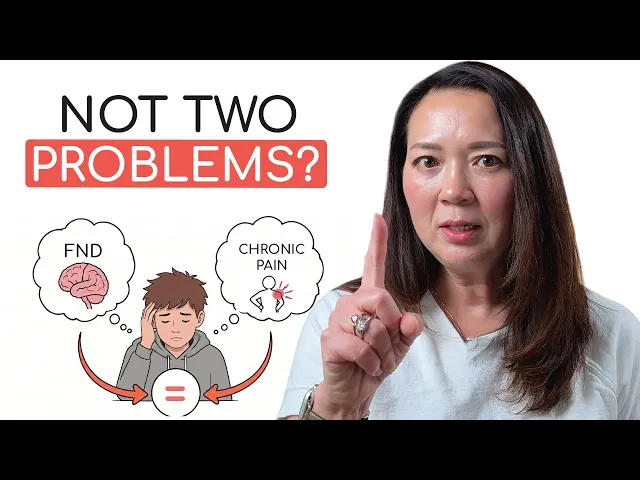
Chronic Pain and FND: What If Your Teen Doesn't Have Two Separate Problems?

Dr. Jin Lee, PsyD
Your teen has FND. And on top of that, they're dealing with chronic pain — daily headaches, widespread body aches, or pain that moves around and never fully resolves.
You've probably been told these are two completely separate problems. Two diagnoses. Two specialists. Two treatment plans. And still, no real progress.
But what if that entire approach is built on the wrong assumption?
What if your teen doesn't have two separate problems at all — but one nervous system running one pattern, and you've been chasing it in two completely different directions?
That's exactly what peer-reviewed research is now confirming. And understanding this single shift can change everything about how your family approaches recovery.
Key Takeaways
FND and chronic pain share overlapping neurobiological processes — they are branches of the same tree, not two separate conditions
A 2022 JAMA Psychiatry trial found that two-thirds of patients with decade-long chronic pain achieved complete or near-complete pain elimination through pain reprocessing therapy, with measurable brain changes on scan
How parents respond to their teen's pain sends powerful safety or threat signals to the nervous system — co-regulation is a neurobiological tool, not just a soft parenting concept
The Research: FND and Chronic Pain Are Connected at the Root
Dr. Kozlowska, one of the leading researchers in pediatric FND, published a comprehensive review in 2024 confirming something families need to hear. A significant proportion of children and adults with FND also report comorbid chronic pain.
More importantly, her research found that chronic complex pain shares overlapping neurobiological processes with FND. Not two separate conditions with two separate mechanisms — one nervous system with overlapping processes producing both sets of symptoms.
What this means in practical terms is powerful. When a teen has both FND and chronic pain, they're not dealing with two unrelated diagnoses. They're dealing with one nervous system that has learned multiple patterns simultaneously — like two branches growing from the same tree.
What's Actually Happening With Chronic Pain
Pain researcher Dr. Lorimer Moseley, a professor of clinical neuroscience at the University of South Australia and one of the most cited pain scientists in the world, has spent decades establishing something that fundamentally changes how we understand pain.
Pain is not a direct readout of tissue damage. Pain is produced by the brain as a protective output — a warning signal generated by the nervous system when it perceives threat, whether or not actual tissue damage is present.
You can have pain with tissue damage (a broken bone). You can have pain without tissue damage (unexplained back pain). And you can even have tissue damage without pain (a bruise you didn't notice until you saw it).
In teens with FND, the nervous system is already in a heightened threat detection mode. The alarm system is already overactive. Chronic pain in this context is that same system doing the same thing in a different domain — generating a signal not because something is structurally broken, but because the nervous system has learned to produce it.
This is called nociplastic pain — pain maintained by learned neural circuits, not by structural damage.
The JAMA Psychiatry Trial That Changes Everything
In 2022, Ashar, Gordon, and colleagues published a randomized controlled trial in JAMA Psychiatry studying adults with chronic back pain. While this study focused on adults rather than teens with FND, it provides compelling supporting evidence for the nociplastic pain framework.
Participants were divided into three groups. The first received pain reprocessing therapy (PRT), which teaches patients to understand their pain as a brain-generated warning signal rather than evidence of tissue damage. The second received an open-label placebo — patients were told upfront they were receiving a saltwater injection with no active ingredients. The third group continued their usual care.
The results were striking. Two-thirds of participants who received pain reprocessing therapy reported complete or near-complete elimination of their chronic back pain — pain they had lived with for an average of over ten years.
Brain scans taken before and after treatment showed actual measurable changes in how the brain processed pain signals. The improvement wasn't just subjective — it was visible in brain functioning.
The mechanism behind this result comes down to one word: neuroplasticity. The brain learned the pain pattern, and with the right conditions, it built a different one.
One Tree, Multiple Branches
What this means for your family is significant. Your teen is not broken in two different places. Their nervous system is running one pattern across multiple symptoms — FND, pain, and potentially more.
What families working with Dr. Lee often see is that when recovery work happens at the level of the nervous system generating both, the FND symptoms and the chronic pain tend to respond together. They go hand in hand because they come from the same place.
What You Can Do Right Now as a Parent
How you respond to your teen's pain matters just as much as the pain itself. When your teen reports pain, their nervous system is sensing you — reading the environment for cues about whether things are safe or threatening.
If your response is anxious — constantly asking about pain levels, rushing to fix it, visibly panicking, or offering medication you know isn't the solution — that signals to your teen's nervous system that the threat is real and the alarm should stay on. The pain amplifies. Not because you caused it, but because the nervous system is reading your response as confirmation of danger.
Here's what steady leadership looks like in practice:
Pause and regulate yourself before you respond
Acknowledge your teen's pain calmly without amplification — you're not dismissing it, you know it's real
Send a different signal — that the environment is safe, that the threat level can come down, that the alarm system doesn't need to stay on
This is co-regulation, and it's not a soft parenting concept. It is literally a neurobiological input. Your regulated nervous system is one of the most powerful tools available for your teen's recovery — and it costs nothing.
If your teen is dealing with both FND and chronic pain, understanding that these are connected — not separate — is the first step toward a more effective path forward. To learn more about how families are applying these principles and helping their teens recover, visit teenfndacademy.com.
References
Kozlowska, K., & Scher, S. (2024). Recent advances in understanding the neurobiology of pediatric functional neurological disorder. Expert Review of Neurotherapeutics, 24(5), 497-516. View study
Ashar, Y. K., Gordon, A., Schubiner, H., Uipi, C., Knight, K., Anderson, Z., Carlisle, J., Polisky, L., Geuter, S., Flood, T. F., Kragel, P. A., Dimidjian, S., Lumley, M. A., & Wager, T. D. (2022). Effect of pain reprocessing therapy vs placebo and usual care for patients with chronic back pain: A randomized clinical trial. JAMA Psychiatry, 79(1), 13-23. View study
Share this
Comments
>No comments yet. Be the first!
Related Post

Scientists Are Learning More About FND: What New Research Reveals
New research is helping scientists better understand Functional Neurological Disorder and why the brain can produce real neurological symptoms even when scans appear normal.
Read more

The Neuroscience of the Teenage Brain: Why Your Reward System Might Need an Upgrade
Neuroscientist Dr. Adriana Galván's research reveals why the teenage brain responds to rewards more intensely than adults — and Dr. Jin Lee explains how parents can use this science to build a reward system that actually works for teens with FND.
Read more

Why "Validating Feelings" Backfires: What FND Parents Need to Know About Holding Space
Validating your teen's feelings during an FND flare sounds like the right move — but if your mindset is still about making it stop, it can backfire. Dr. Jin Lee breaks down what holding space actually looks like for FND families.
Read more