
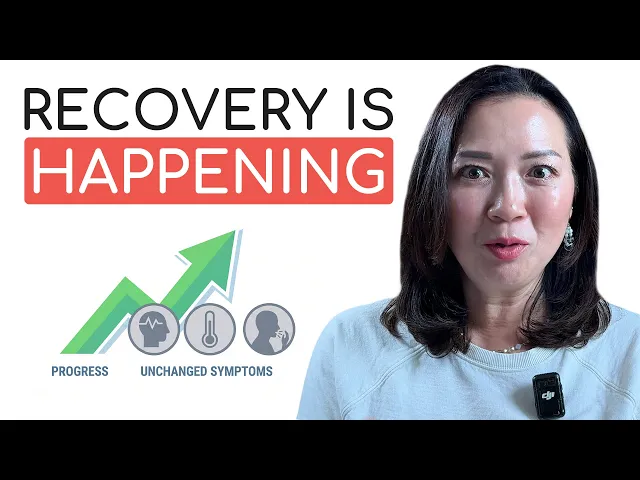
5 Signs Your Teen Is Making FND Recovery Progress — Even When Symptoms Are Still There

Dr. Jin Lee, PsyD
When your teen has Functional Neurological Disorder, the most natural thing in the world is to count symptoms. Fewer symptoms equals progress. More symptoms equals setback. Right?
Not exactly.
What families often discover is that symptom count alone can be misleading. Symptoms can go up and down while your teen is making very real, meaningful progress underneath. The problem is that if you're only watching the symptoms, you might completely miss the changes that actually matter most.
Dr. Jin Lee, pediatric psychologist and founder of Teen FND Academy, breaks down five specific signs that your teen is moving forward in their FND recovery — even when symptoms are still showing up. She also walks through the four stages of recovery and explains why you don't have to wait for symptoms to disappear before recognizing that genuine progress is happening.
Key Takeaways
Measuring FND recovery by symptom count alone is the most common mistake families make — symptoms can fluctuate while your teen is making real progress.
Recovery moves through four stages: reacting, learning, practicing, and living beyond FND — and your teen doesn't have to wait for symptoms to disappear to move through them.
The five signs of progress include: faster bounce-back after flares, more participation in life, symptoms taking up less emotional space, growing independence, and your family getting its normal life back.
Research supports measuring recovery beyond symptoms alone — including functional independence, quality of life, and reduced impact on daily living.
Why Symptom Count Isn't the Whole Story
When FND is part of your family's life, symptoms feel like the scoreboard. Muscle twitches, non-epileptic seizures, tremors, brain fog, pain, fatigue — when they decrease, it feels like winning. When they flare up, it feels like losing ground.
But here's what families often find: fewer symptoms can absolutely be a sign of progress, but symptoms can also go up and down while your teen is making very real strides forward. If you're only watching that one metric, you could miss the bigger picture entirely.
The Four Stages of FND Recovery
Dr. Lee teaches families to think about recovery as a journey through four stages — and it's never perfectly linear.
Reacting: A symptom happens and everything stops. The symptom is driving your family's life.
Learning: You're starting to understand what FND is, what it isn't, and what to do differently.
Practicing: You're actually using those skills when symptoms show up — not just knowing about them.
Living beyond FND: FND is no longer running your teen's life or yours.
The really important part? You don't have to wait for symptoms to disappear before moving through those stages. Some families move quickly from reacting to learning, briefly dip back into reacting when something unexpected happens, and then return to practicing. The key is that reacting is no longer their home base.
Sign 1: Your Teen Bounces Back Faster
Early on, a symptom flare might take out the entire day — or even weeks. But over time, the same symptom happens and your teen follows their plan, uses their strategies, and gets back to what they were doing. What used to take the rest of the day now takes an hour. Eventually, maybe 20 minutes.
Families Dr. Lee has worked with describe this shift powerfully. One parent couldn't even go to the gym because she couldn't be away from her phone for a second — always on standby like a firefighter. Later in recovery, she put the phone in her locker and took a full class with confidence because her teen had a plan and knew what to do.
Sign 2: Your Teen Is Participating More
This shows up at school, with friends, at family events, and at home. Your teen may not be doing everything they used to do just yet — and that's okay. The question is: are they participating more? Are they staying longer? Are they getting back to activities after symptoms show up?
School is a great example. School isn't a place for your teen to prove they're better. Going to school is part of getting better.
A 2020 consensus paper published in the Journal of Neurology, Neurosurgery & Psychiatry brought together expert recommendations for FND rehabilitation. The goals went beyond reducing symptoms to include helping people return to daily activities, build independence, and participate in their lives again.
Sign 3: Symptoms Take Up Less Space in Family Life
This one can be subtle at first. Early on, FND becomes the center of everything — constant checking, constant discussion, constant fear. But over time, that changes. Symptoms may still happen, but there's less checking, less urgency, and less fear.
Your teen starts thinking, "I know what this is. I've got this." And you start thinking, "We have a plan." Everyone responds instead of reacts.
Dr. Lee teaches families to think about FND symptoms as smoke, not the fire. The smoke is real — you don't ignore it. But you also don't spend the entire day staring at it. The real work is addressing that miscommunication between the brain and the body, which is essentially what FND is.
Sign 4: Your Teen Is Becoming More Independent
Maybe they used to call you every single time symptoms started. Now they try their plan first. Maybe they used to immediately ask, "What should I do?" Now they're starting to think, "Actually, I know what to do."
This is a huge shift. Many teens with FND feel like things are out of control. Recovery is about regaining that sense of empowerment — starting with, "I can do this. I know what to do." That's the difference between learning and practicing. Learning is knowing what you're supposed to do. Practicing is doing it while symptoms are actually happening.
Sign 5: Your Family Is Getting Its Normal Life Back
This may be the biggest sign of all. Think about what happened when FND first took over — plans cancelled, someone always on standby, siblings planning around FND, parents leaving jobs to become 24-hour caregivers.
Then slowly, life starts opening back up. You go out to dinner. Your teen sees a friend. Siblings get more of your attention. You stop organizing everyone's life around what FND might do next.
FND may still show up, but it's no longer running the household. That's what living beyond FND starts to look like.
A 2025 systematic review looking at how outcomes are measured in psychological interventions for children and teens with FND found that meaningful outcomes went beyond symptoms alone — they included functional independence, quality of life, and the impact FND has on everyday life.
How to Zoom Out
When you're trying to figure out whether your teen is getting better, move beyond "Are there fewer symptoms?" and start asking: Where are we in this recovery journey? Are we still reacting every time? Are we learning what to do? Are we actually practicing those skills? Are we starting to have days where we're simply living our lives again?
Yes, we want symptoms to improve. But don't wait until every symptom disappears before you recognize that recovery is happening. Sometimes one of the clearest signs of progress isn't "My teen didn't have symptoms today." It's "My teen had symptoms today — and knew exactly what to do — and got back to their life faster than before."
If you want help applying these principles and building a clear, structured recovery plan for your teen and your family, visit teenfndacademy.com to learn more about Teen FND Academy and see if the program is a good fit for you.
References
Nicholson, C., Edwards, M. J., Carson, A. J., Gardiner, P., Golder, D., Hayward, K., Humblestone, S., Jinadu, H., Lumsden, C., MacLean, J., Main, L., MacGregor, L., Nielsen, G., Oakley, L., Price, J., Ranford, J., Ranu, J., Sum, E., & Stone, J. (2020). Occupational therapy consensus recommendations for functional neurological disorder. Journal of Neurology, Neurosurgery & Psychiatry, 91(10), 1037–1045. View study
Outcome measurement in psychological interventions for paediatric functional neurological disorder: A systematic review. (2025). Clinical Child Psychology and Psychiatry. View study
Share this
Comments
>No comments yet. Be the first!
Related Post
Functional Neurological Disorder in Teens: What Parents Need to Know
FND can cause seizures, paralysis, dizziness, and other neurological symptoms in teens—even when medical tests look normal. Understanding what’s happening in the brain is the first step toward recovery.
Read more
The Hidden Causes of Teen FND: Why Symptoms Suddenly Appear
Functional Neurological Disorder in teens often seems to come out of nowhere. Understanding the hidden factors that affect the brain and nervous system can help families make sense of the symptoms.
Read more
The Surprising Truth About Teen FND: Why Symptoms Aren’t What They Seem
Functional Neurological Disorder can cause serious neurological symptoms even when brain scans look normal. Understanding what’s actually happening in the brain can change how families approach recovery.
Read more