A New Study Reviewed 50 FND Videos on YouTube — But There's a Bigger Problem

Dr. Jin Lee, PsyD
When your teen is diagnosed with FND, what do you do when no one tells you what comes next?
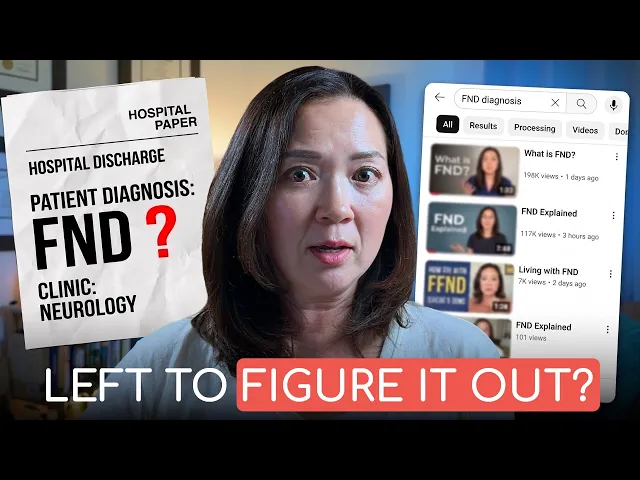
For many families, the answer is: you search. You search at 2am, scrolling through YouTube videos, reading articles, joining online groups — not because you distrust your doctors, but because you were handed a diagnosis without an explanation of how recovery actually works.
A recent study set out to evaluate the reliability of the 50 most-watched YouTube videos about Functional Neurological Disorder. The findings were revealing — but for Dr. Lee, the bigger question was one the study didn't ask: why are families searching in the first place?
This post walks through the study's key findings, the recommendations the researchers made, and the systemic gap that drives so many parents to become DIY FND experts they were never meant to be. It also offers four practical things to look for when evaluating FND information online.
Key Takeaways
Across 50 of the most-viewed FND videos, information quality was inconsistent — and popularity (views and likes) was not a reliable signal of accuracy.
It made no statistically significant difference whether a physician, hospital, or other creator produced the video.
Many families search online not out of carelessness, but because they received a diagnosis without a clear recovery plan or practical guidance.
A diagnosis alone is not a recovery plan — and neither is a referral to a therapist unfamiliar with FND or a months-long waitlist with no direction.
Four things to look for in FND content: health source credibility signals, science-based expertise with real FND experience, a recovery-oriented tone, and guidance that includes parents as active participants.
What the Study Actually Found
Researchers pulled the 50 most-viewed YouTube videos about FND and evaluated them in three areas: overall quality and usefulness, reliability of sourcing and balance, and whether they met basic standards for health information.
The short answer across all 50 videos? Sometimes.
Some videos provided useful FND education. But as a group, the quality was inconsistent, and reliability was rated as moderate. Some videos lacked clear sourcing or transparency about where their information came from.
Two Findings Worth Sitting With
First, popularity was not a reliable measure of quality. A video having lots of views or likes did not mean its information was more accurate or trustworthy than lesser-known videos.
Second — and this one is striking — the researchers did not find statistically significant differences in quality based on who produced the video. Whether it came from a physician, a hospital, or another type of creator, the quality didn't measurably differ. (The researchers noted that some of these groups were small, so this needs careful interpretation.)
Their recommendation was straightforward: clinicians and professional organizations need to create more evidence-based, patient-centered FND education. And healthcare professionals should actively guide patients toward reliable resources rather than leaving them to sort through online information alone.
The Question the Study Didn't Ask
The study examined what families find online. But Dr. Lee's question is: why are so many families searching in the first place?
What families I've worked with describe over and over is a gap — not a gap in trust, but a gap in guidance. Many families receive a diagnosis of FND but don't get a clear explanation of how recovery happens or what they should do next.
Some were told that medical tests were normal. Some were told symptoms were caused by stress and that therapy was all they needed. Others were referred to a specialty program at a major hospital and expected to wait months — without any practical direction about what to do in the meantime.
So the parents begin searching. They're not being careless. They're being resourceful, because their child is struggling and they don't have the luxury of putting life on hold.
A Diagnosis Is Not a Recovery Plan
Giving a diagnosis is not the same thing as guiding a family toward recovery. Ordering another test is not recovery. And simply telling a family to find a therapist — especially one who doesn't understand FND — is not a recovery plan either.
A waitlist without guidance about what the family can do now is not enough. In the meantime, the family is still struggling, the parent doesn't know how to respond, and no one has given them a clear direction.
That lack of expert-led guidance is what pushes parents into a role they were never meant to play: the DIY FND semi-expert. They piece together videos, articles, and advice from online groups, trying to build a plan from disconnected fragments — without the training or experience to evaluate what they're finding.
How to Spot Reliable FND Content Online
While healthcare systems work toward providing better FND education, families still need practical ways to evaluate what they find. Here are four things to look for:
1. Check for credibility signals. YouTube has a health source information panel that appears under certain health-related videos. Channels must meet specific professional licensing, content, and platform requirements to qualify. It's not a guarantee that every statement is correct, but it provides helpful context about the source.
2. Look for science-based expertise and real FND experience. Are explanations grounded in current neuroscience and evidence-based research? Beyond a professional title, does this person have substantial experience helping teens and families move toward recovery? Credentials matter — but experience applying that knowledge to real FND recovery matters too.
3. Listen to the tone. Is this recovery-oriented? Does it help you understand how your teen can rebuild function and return to life — or does it leave you feeling like FND is a permanent sentence? Recovery-oriented information should never promise a quick cure or a magic pill. But it should help families see what improvement is possible and understand what the recovery process involves.
4. Ask whether it includes you as a parent. Does it help you understand what you can do to support your child's recovery — how to respond to symptoms, approach routines, set expectations, support independence, and help your teen re-engage with life? Parents are not simply observers in pediatric FND recovery. You don't need to become the FND expert, but you do need the guidance and skills to become a steady leader in your household.
The Bigger Takeaway
The study's finding — that FND information online is sometimes reliable — is valuable. But the deeper issue is why families are being left to search on their own in the first place. They're not searching because they don't respect medical expertise. They're searching because they received a diagnosis without enough education, expert guidance, or a practical path forward.
The goal is to give families the guidance they need to help their teen get their life back. If you've been trying to piece together an FND recovery plan on your own, you don't have to keep doing this alone. Learn more about how Teen FND Academy helps families move from survival mode to a structured path forward at teenfndacademy.com.
References
Alpua, M., & Yoldaş, T. K. (2026). Functional neurological disorder on YouTube: How reliable is the information? Frontiers in Public Health, 14, 1802156. View study
Share this
Comments
>No comments yet. Be the first!
Related Post
Functional Neurological Disorder in Teens: What Parents Need to Know
FND can cause seizures, paralysis, dizziness, and other neurological symptoms in teens—even when medical tests look normal. Understanding what’s happening in the brain is the first step toward recovery.
Read more
The Hidden Causes of Teen FND: Why Symptoms Suddenly Appear
Functional Neurological Disorder in teens often seems to come out of nowhere. Understanding the hidden factors that affect the brain and nervous system can help families make sense of the symptoms.
Read more
The Surprising Truth About Teen FND: Why Symptoms Aren’t What They Seem
Functional Neurological Disorder can cause serious neurological symptoms even when brain scans look normal. Understanding what’s actually happening in the brain can change how families approach recovery.
Read more