
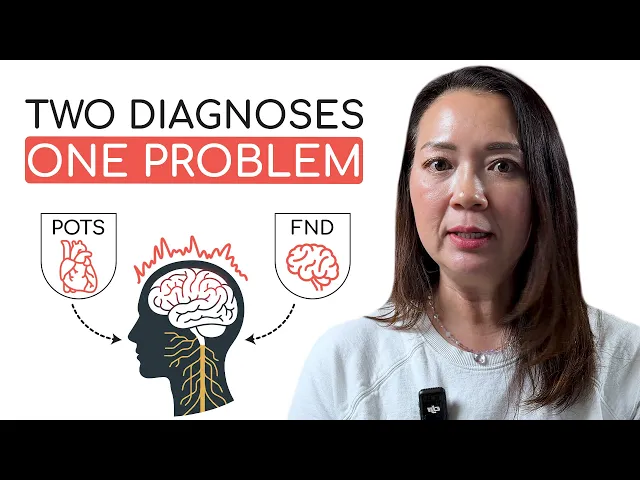
Why Treating POTS and FND Separately Is Keeping Your Teen Stuck

Dr. Jin Lee, PsyD
Two diagnoses. Two sets of specialists. Two separate treatment plans. And still, nobody has explained why your teen has both POTS and FND at the same time — or what to do about it.
If this sounds like your family's reality, you're not alone. What we often see is that families end up stuck in an exhausting loop of appointments and referrals, with each specialist working in their own lane but no one connecting the dots between both conditions.
The truth is, POTS and FND are not two entirely separate problems. Recent research is confirming what families I've worked with have experienced firsthand: both conditions are driven by the same nervous system dysregulation. And until that shared driver is addressed, symptom management alone is unlikely to move the needle.
Dr. Jin Lee breaks down the science, walks through a real-world composite story, and explains why a whole-nervous-system approach is the key to helping teens with both diagnoses move toward recovery.
Key Takeaways
POTS and FND are not two separate problems — they share the same underlying nervous system dysregulation
Conventional POTS treatment manages symptoms but often misses the central nervous system driver keeping the cycle going
A 2026 study in Clinical Autonomic Research supports understanding POTS as a central nervous system disorder, not just a cardiovascular one
POTS Reprocessing Therapy (PORT) uses the same mechanism as FND recovery: retraining the brain's threat response
A whole-nervous-system, whole-family approach addresses both conditions together instead of chasing each diagnosis separately
What POTS Actually Is — And Why It Sounds So Familiar
POTS stands for postural orthostatic tachycardia syndrome. In plain language, when your teen stands up, their heart rate spikes far more than it should. The result? Dizziness, lightheadedness, brain fog, fatigue, nausea, and sometimes fainting.
The gold standard for confirming a POTS diagnosis is the tilt table test. Your teen lies flat on a table that tilts upward to a near-standing position while heart rate and blood pressure are monitored. In adolescents, a heart rate increase of 40 beats per minute or more within the first 10 minutes confirms the diagnosis — as long as blood pressure stays relatively stable.
Here's the part that matters most: the heart itself is structurally fine. All the tests for structural damage come back normal. The problem isn't the hardware — it's how the system is functioning.
If that sounds familiar, it should. It's the same framework used to understand FND. Not a broken structure, but a nervous system running a pattern it shouldn't be running.
Why POTS and FND Are Not Two Separate Problems
Dr. Thomas Chelimsky, a neurologist at Virginia Commonwealth University who has spent his career studying functional autonomic disorders, describes it this way: when you run a diagnostic on a computer and the hard drive comes back fine, the problem isn't the hardware — it's the software.
POTS is a software problem. FND is a software problem. And when both show up in the same teen at the same time, it's likely because the same nervous system is dysregulated.
This isn't a coincidence. What we often see is that these conditions travel together precisely because they share a common root: a nervous system that has lost its ability to regulate properly and is stuck in a threat response.
Why Conventional POTS Treatment Keeps Missing the Real Driver
The traditional approach to POTS focuses on managing symptoms from the outside in. Salt and fluid loading to increase blood volume. Compression socks to prevent blood pooling. Graded exercise through physical therapy. And for some teens, medication on top of it all.
These tools are not wrong. For many families, they provide real, meaningful relief. But they're all aimed at peripheral symptoms — heart rate, blood pressure, blood volume — while nobody asks why the nervous system is generating these signals in the first place.
When the conventional approach plateaus, most families hit a wall. More medication adjustments, more PT, more symptom management. But the underlying system driving the symptoms stays completely untouched.
What the 2026 Research Changes
This is where the research by Crouch, Chelimsky, and colleagues becomes critically important. Their 2026 study in Clinical Autonomic Research argues that POTS is better understood as a central nervous system disorder — not primarily a cardiovascular disease.
In plain English: the persistent symptoms of POTS may be driven by a nervous system stuck in a threat response. The brain has essentially learned to treat the act of standing up as dangerous, so it triggers an alarm that keeps firing even when no real danger exists.
Based on this framework, the team developed POTS Reprocessing Therapy (PORT), adapted from Pain Reprocessing Therapy (PRT), an evidence-based approach for centralized chronic pain. The core of PORT is teaching the nervous system that the symptoms are not the emergency the brain thinks they are.
This is early research — the full trial is still underway — but the direction it points is significant. It mirrors the same mechanism at the heart of FND recovery: retraining the brain's threat response rather than just managing what that response produces.
What Happens When Both Conditions Go Unconnected
Families I've worked with describe a pattern that repeats itself. A teen gets diagnosed with POTS. Treatment starts and things feel somewhat manageable. But then new symptoms emerge — tremors, legs giving out, stretches of exhaustion lasting days or weeks. School attendance drops. The world gets smaller.
Eventually a second diagnosis arrives: FND. And suddenly it feels like starting from zero.
But these families aren't starting from zero. Nobody gave them the framework to see that both conditions were part of the same picture. The POTS treatment managed some symptoms, but the underlying nervous system was still running a threat response — and over time, that expanded into more and more symptoms.
What a Whole-Nervous-System Approach Looks Like
Chasing each diagnosis separately — with the cardiologist managing POTS and the neurologist managing FND — will likely keep your family stuck longer. Each specialist is doing their best within their lane, but nobody is working from a single framework that addresses the system underneath both conditions.
That shared mechanism — a nervous system that learned to stay in a threat state and can't find its way out — is what needs to be addressed. And this process is built to work with the whole family, not just the teen, and not symptom by symptom.
Medication and physical therapy are not wrong. They actually work best when the family is also addressing the nervous system piece. Without that, you're putting out individual flames while the house keeps burning.
If your teen has both diagnoses, or if you're watching POTS symptoms expand into something that looks more like FND, there is a reason that happens — and there is a framework for addressing both together. To learn how families are navigating this and helping their teens move toward recovery, visit teenfndacademy.com.
References
Crouch, T. B., Nguyen, M., Wells, M., Redman, T., Ashar, Y., Schubiner, H., Westcott, G., Kinser, P., Maxwell, M., Chelimsky, G., & Chelimsky, T. (2026). An alternative "Port"? Rationale and development process for POts Reprocessing Therapy (PORT), a brain-body therapy for postural tachycardic syndrome (POTS). Clinical Autonomic Research, 36, 373-385. View study
Share this
Comments
>No comments yet. Be the first!
Related Post
Functional Neurological Disorder in Teens: What Parents Need to Know
FND can cause seizures, paralysis, dizziness, and other neurological symptoms in teens—even when medical tests look normal. Understanding what’s happening in the brain is the first step toward recovery.
Read more
The Hidden Causes of Teen FND: Why Symptoms Suddenly Appear
Functional Neurological Disorder in teens often seems to come out of nowhere. Understanding the hidden factors that affect the brain and nervous system can help families make sense of the symptoms.
Read more
The Surprising Truth About Teen FND: Why Symptoms Aren’t What They Seem
Functional Neurological Disorder can cause serious neurological symptoms even when brain scans look normal. Understanding what’s actually happening in the brain can change how families approach recovery.
Read more