
Why Your Teen's FND Plateau Is Not the End of Their Recovery (Jackson's Story)

Dr. Jin Lee, PsyD
If your teen with FND has made progress but now seems stuck — still relying on a wheelchair, still unable to do the things they love — you may be wondering: Is this as good as it gets?
That's exactly where Jackson and his family were a year ago. Jackson had recovered from almost every FND symptom except one. He still could not walk. He was in a full-time wheelchair. And the question lingering over the family was whether this plateau was permanent.
Fast forward to today: Jackson is driving. He's hiking on uneven terrain. He completed his senior marching band camp. He attended an FBI teen camp. And he did all of it without giving up during the long, uncertain middle.
In this conversation, Dr. Jin Lee sits down with Jackson and his dad, Dale, to talk about what happened after the plateau — the mindset shifts, the family decisions, and the steady forward motion that brought Jackson back to his life.
Key Takeaways
A recovery plateau does not mean your teen has reached their ceiling — breakthroughs can happen after months or even years of steady effort.
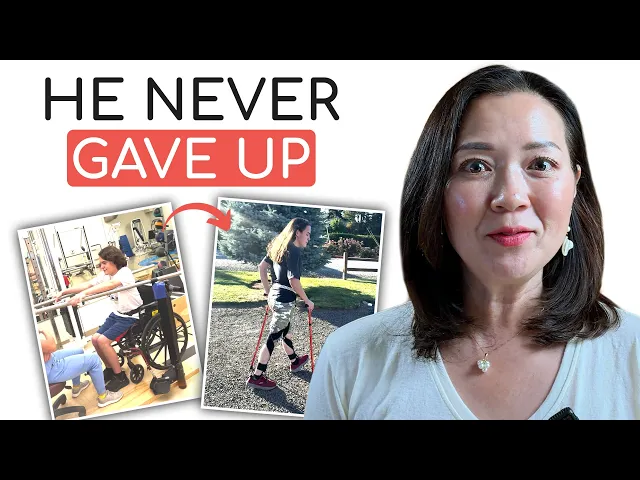
Jackson progressed from a full-time wheelchair to canes to walking, driving, hiking on uneven terrain, and completing marching band camp.
The family's decision to hold off on permanent assistive adaptations (like hand controls in the car) became a turning point in Jackson's mindset and progress.
Parental steady leadership — supporting without fixing — played a critical role in Jackson owning his recovery.
Community and connection with other families navigating FND helped both Jackson and his dad, Dale, stay the course during the hardest stretches.
A Diagnosis With No Road Map
When Jackson was first diagnosed with Functional Neurological Disorder, his family received very little guidance. His neurologist identified the condition but didn't offer much direction on what to do next.
What followed was a frustrating cycle that many FND families know all too well. The neurologist pointed to the psychologist. The psychologist pointed to the pediatrician. The pediatrician pointed back to the neurologist. One physical therapy office quoted a 16-month wait list.
Dale described those early days as "grueling" — a parent desperately searching for someone, anyone, who understood what was happening and how to help.
What the Plateau Actually Felt Like
Before FND, Jackson was deeply active — karate, track and field, basketball, tennis. When his symptoms took hold, including functional paralysis, memory issues, and loss of sensation in his legs, that entire identity was disrupted.
Over time, Jackson made significant progress. Many symptoms resolved. But walking remained stubbornly out of reach. He was still in a full-time wheelchair, and the progress had slowed to what felt like a standstill.
What kept Jackson going was something simple but powerful: knowing he wasn't alone. Having connection with other teens facing similar struggles through the Teen FND Academy community gave him the reassurance that this was not a dead end.
The Decision That Changed Everything
One of the most pivotal moments in Jackson's journey came around the topic of driving. Like any teenager, Jackson wanted to get behind the wheel — especially watching his twin brother already start to drive.
The family faced a real crossroads: should they install hand controls in the car so Jackson could drive now, or hold off with the expectation that he would regain the ability to use his legs?
They chose to wait. And that decision unlocked something in Jackson's mindset. As he described it, it flipped a switch — he knew he could do it, but he had to put in the work to get there.
The first time Jackson sat behind the wheel and actually moved the car using his legs, Dale could barely believe it. From that point on, progress accelerated.
From Wheelchair to Walking — Step by Step
Jackson's progression was not a single dramatic moment. It was a series of deliberate, incremental steps:
Full-time wheelchair
Part-time wheelchair, part-time walker with adaptive straps
Forearm crutches
Standard walker
Canes
An elastic exoskeleton support with one cane for marching band and physical therapy
Each transition was earned through consistent effort. And alongside the physical progress, Jackson was getting his life back — completing a two-week marching band camp in the sun, walking around New York City, exploring college campuses in Oregon, and finishing an FBI teen camp.
Steady Leadership as a Parent
Dale was honest about how hard it was to step back. Every instinct told him to find the fix, to solve it, to make it better. But what he learned through the process was that Jackson needed to own his recovery.
That didn't mean Dale abandoned him. It meant showing up consistently, being present, and trusting the process even when progress was painfully slow. Dale credits the parent meetings and community support with helping him shift into what Dr. Lee calls a "steady leader" — present and supportive without taking over.
As Dale put it, the whole family eventually committed to the same direction: they would stop leaning on accommodations as a permanent solution and hold the expectation that Jackson would continue to improve.
What Jackson and Dale Would Tell Families Losing Hope
Dale's message was clear and direct: stay the course. He described the journey from being the new, overwhelmed parent to becoming someone who could support other families just starting out. Progress, he emphasized, is not linear — there will be dips and heartbreak, but the upward trend continues.
Jackson's advice to other teens was equally straightforward: keep pushing. Plateaus are real, and they can feel permanent, but they are not the final chapter.
Recovery Is a Long Road — But It Doesn't Have to Be a Lonely One
Jackson's story is not about quick fixes or overnight breakthroughs. It's about what becomes possible when a teen, a family, and a supportive community stay committed to the process over the long haul — even when progress seems invisible.
If your family is navigating FND and feeling stuck, know that what you're experiencing is a common part of the journey. And with the right structure, guidance, and community, the plateau doesn't have to be the end.
To learn more about how families are helping their teens move forward with FND, visit teenfndacademy.com.
Share this
Comments
>No comments yet. Be the first!
Related Post

Scientists Are Learning More About FND: What New Research Reveals
New research is helping scientists better understand Functional Neurological Disorder and why the brain can produce real neurological symptoms even when scans appear normal.
Read more

Chronic Pain and FND: What If Your Teen Doesn't Have Two Separate Problems?
Research shows FND and chronic pain share overlapping brain mechanisms — not separate conditions. Dr. Jin Lee explains why this changes everything about how families approach recovery.
Read more

From Crutches to Lifting Weights: How Abby's Family Found Their Way Through FND
Six months ago, Abby couldn't walk 20 feet without stopping. Today she's at the gym lifting weights, applying for jobs, and getting her life back — and it started when her whole family committed to a new approach.
Read more