
What a Harvard Review Revealed About Full FND Recovery — And Why CBT Alone Keeps Families Stuck

Dr. Jin Lee, PsyD
Your teen has been in CBT for months. Maybe years. You've shown up to every appointment, done every homework assignment, tried everything the therapist suggested. And your teen is still having episodes. Still missing school. Still missing life.
If that sounds like your family, you're not doing anything wrong. What families in this situation are usually missing isn't more effort — it's a critical piece of the recovery road map that most doctors never explain.
A 2023 peer-reviewed study published in the Harvard Review of Psychiatry found that 63 to 95% of children with FND achieve full symptom resolution when a biopsychosocial approach is used — one that addresses the biological, psychological, and social layers together. Not just one layer in isolation.
So why are so many families still stuck after months of therapy? And what's the missing piece that changes everything?
Key Takeaways
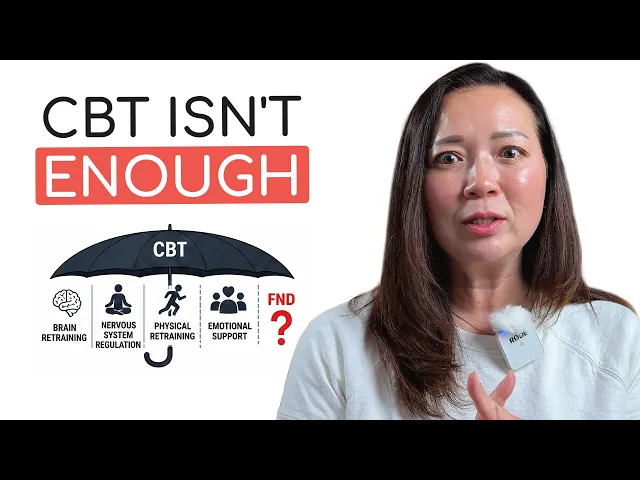
CBT is not one thing. It's an umbrella term with dozens of specializations — and the wrong match keeps teens stuck, even with a great therapist.
63 to 95% of children with FND achieve full symptom resolution when all three layers of recovery are addressed together.
Recovery is bigger than symptom elimination. It means getting your teen back to school, friendships, confidence, and life.
Most families are rowing hard with only one oar — doing the right things without the right understanding of how FND works.
The brain is not stuck forever. Neuroplasticity means new pathways can be built through the right approach.
Why CBT Isn't Working — Even When You're Doing Everything Right
When a doctor tells you to "find a CBT therapist," they're handing you a category — not a specific tool and not a road map. CBT is an umbrella term that covers dozens of different approaches: CBT for trauma, CBT for OCD, CBT for chronic pain, CBT for insomnia, and many more.
Each specialization is designed for a specific condition and a specific set of needs. So when an exhausted parent types "CBT therapist near me" into Google at midnight, they usually find someone licensed, experienced, and well-reviewed — but someone who has never worked with functional neurological disorder.
Think of it like needing knee surgery. You could find a neurosurgeon, a plastic surgeon, or an oral surgeon — all board-certified, all highly trained. But none of them specialize in knees. That mismatch matters enormously. It's not the wrong profession. It's the wrong specialization.
What Full FND Recovery Actually Looks Like
Many families define recovery as "the episodes stop completely." And yes, that is absolutely part of the goal. But recovery from FND is actually much bigger than symptom elimination alone.
Real recovery means getting your teen's life back. Back to school. Back to friendships. Back to feeling in control of their own body. Back to being a teenager. Back to family normalcy — whatever that looks like for you.
What we often see is that when families expand their definition of recovery beyond just "no more symptoms," the entire path forward becomes clearer and more achievable.
What the Harvard Review of Psychiatry Study Found
A 2023 peer-reviewed paper published in the Harvard Review of Psychiatry by Dr. Kozlowska and colleagues reviewed the evidence on mind-body, biopsychosocial interventions for children and adolescents with FND.
The findings were striking: full resolution of FND symptoms occurs in 63 to 95% of children when a biopsychosocial approach is used — one that addresses the biological layer, the psychological layer, and the social layer together. Not just one layer. Not random CBT alone. All three working in concert.
This is exactly the framework that families I've worked with learn to apply — addressing what's happening in the brain and nervous system, the psychological patterns at play, and the social and environmental factors that keep the cycle going.
The Rowing Boat Analogy — Why One Oar Keeps You Going in Circles
Recovering from FND is like rowing a boat. You need both oars working together to move forward.
One oar is doing the right things — and most families are already working incredibly hard on this side. CBT, physical therapy, occupational therapy, supplements, medications, relaxation strategies, meditation, acupuncture. These are all real tools that have a place.
But if that's the only oar in the water, no matter how hard you row, you keep going in circles. This is what families often describe as the "stuck cycle."
The second oar is the right understanding. Not positive thinking. Not pretending everything is fine. It's a real understanding of how the mind and body work as one unit — what FND actually is at the neurological level, what your teen's brain and nervous system need to start building new pathways, and what recovery looks like when you see the full picture.
This knowledge and understanding is the oar most families are missing. Not because they aren't trying — because simply nobody gave them the full road map.
Your Teen's Brain Is Not Stuck Forever
This is the part that gives the most hope. The brain is not stuck forever. That is what neuroplasticity means.
The FND pattern has been strengthened through repetition. But new pathways can also be built through repetition — through the right approach applied consistently. The brain can learn new patterns. The nervous system can be recalibrated.
Families I've worked with who spent months or years in therapy weren't doing anything wrong. They were rowing as hard as they could with one oar. They didn't need to start over. They needed the second oar — the understanding of what FND actually is, how their teen's brain and body work together, and what recovery looks like when you have the complete road map.
Once both oars are in the water, things start to move. Families aren't going in circles anymore.
If your family has been stuck in this cycle — doing everything you were told and still not seeing progress — there is a path forward. You can learn more about how the Teen FND Academy program gives families both oars at teenfndacademy.com.
References
Kozlowska K, Chudleigh C, Savage B, Hawkes C, Scher S, Nunn KP. Evidence-Based Mind-Body Interventions for Children and Adolescents with Functional Neurological Disorder. Harvard Review of Psychiatry. 2023;31(2):60-82. View study
Share this
Comments
>No comments yet. Be the first!
Related Post

Why "Validating Feelings" Backfires: What FND Parents Need to Know About Holding Space
Validating your teen's feelings during an FND flare sounds like the right move — but if your mindset is still about making it stop, it can backfire. Dr. Jin Lee breaks down what holding space actually looks like for FND families.
Read more

6 Sleep Rules Every FND Parent Should Know
Sleep isn't a nice-to-have for teens with FND — it's the nightly nervous system reset that makes everything else in recovery work better. Here are six practical steps to help your teen build real sleep habits.
Read more

FND at School: What Educators Should (and Shouldn't) Do to Support a Teen's Recovery
Well-intended school responses to FND episodes — like calling 911 or sending students home — can actually work against recovery. Dr. Jin Lee explains what schools should do instead and how families and educators can build a practical plan together.
Read more