
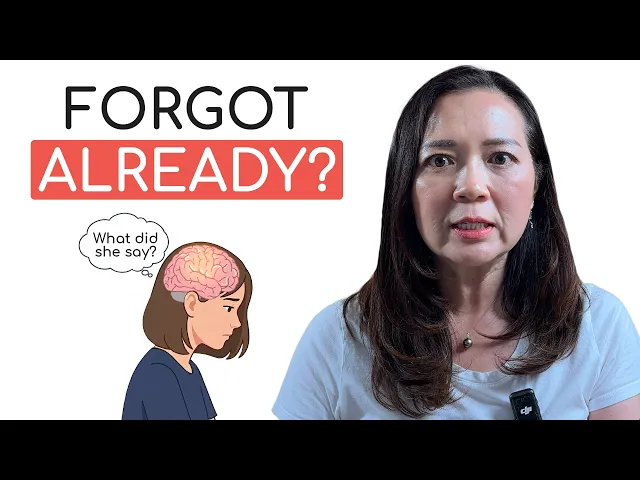
This May Be Why Your Teen Can't Remember What You Said 5 Minutes Ago (Brain Science Explained)

Dr. Jin Lee, PsyD
Your teen zones out mid-conversation. They lose their train of thought before finishing a sentence. They forget what you told them five minutes ago.
If this sounds familiar, you've probably wondered whether they're tuning you out, not trying hard enough, or being dramatic. But if your teen has Functional Neurological Disorder (FND), chronic fatigue, or chronic pain, what you're seeing isn't attitude — it's a brain that has shifted its resources.
Brain fog in FND is a documented, research-confirmed, brain-based symptom with a specific mechanism behind it. And once you understand what's actually happening inside your teen's brain, the way you interact with them can change for the better.
In this post, Dr. Jin Lee breaks down two peer-reviewed studies that explain why brain fog happens in teens with FND — and shares one practical communication shift you can start using today.
Key Takeaways
Brain fog is a real, research-confirmed symptom in teens with FND — affecting attention, executive function, and memory
The brain's attention budget gets redirected from thinking toward threat-scanning, which is why cognitive tasks become so difficult
Chunking instructions into one step at a time helps match your ask to what your teen's brain can actually process right now
What the Research Says About Brain Fog in FND Teens
Dr. Kozlowska, one of the leading researchers in pediatric FND, published a 2024 review that named brain fog as a real, documented symptom in children with FND. Her team noted that children with FND commonly report that schoolwork is challenging because of problems with concentration, attention, and clarity of thought.
Her team tested 57 kids with FND using neurocognitive assessments. The results confirmed that three specific domains were affected: attention, executive function (the ability to stop, think, and plan), and memory.
But here's where it gets really interesting.
Why FND Teens Actually Outperform Healthy Peers at Reading Emotions
That same group of 57 kids actually performed better than healthy controls on a facial recognition task. Their reaction time for identifying other people's emotions was faster than kids who didn't have FND.
What does this tell us? Their brains hadn't stopped working. Their brains had shifted.
Resources that would normally go toward thinking, concentrating, and remembering had been redirected toward scanning for threat, reading emotional cues, and detecting danger. Dr. Kozlowska describes this explicitly as a shift away from cognitive processing and toward emotion and sensory processing — exactly what happens when the fight-or-flight system is on high alert.
Your teen isn't checked out. Their brain is on high alert. And when that's happening, thinking clearly isn't the priority. Survival is.
Why Routine Tasks Become Exhausting
A systematic review by Teodoro and colleagues, published in the Journal of Neurology, Neurosurgery and Psychiatry, looked at 186 studies across three conditions: FND, fibromyalgia, and chronic fatigue syndrome.
Their findings help explain the mechanism behind brain fog. The brain has a limited attention budget. In a settled nervous system, most of that budget goes outward — toward conversations, tasks, and remembering what was just said.
But when the body is dealing with pain, fatigue, or constant internal monitoring, a large portion of that budget gets redirected inward. That leaves less available for everything else. Thinking slows down. Following conversations becomes difficult. Memory becomes unreliable.
Not because the brain is damaged — but because its resources are being used elsewhere.
Their team also found that tasks that would normally run on autopilot get pushed into "manual mode" — making them slow, effortful, and draining. This is why your teen might say things like, "I used to just do this, and now I can't." They're not being dramatic. The task genuinely costs more cognitive energy than it used to.
The Cognitive Stuck Loop: Memory Perfectionism
Teodoro's team also proposed that these experiences can be amplified by something called memory perfectionism. A teen notices a cognitive slip, gets upset about it, which feeds more internal monitoring, which makes the next slip more likely.
What we often see is this cycle playing out every day: a teen forgets something, panics about forgetting it, focuses on the forgetting — and now their brain has even less capacity for the next task. The stuck loop continues.
Understanding Changes How You Show Up
When you understand that your teen's brain has shifted its resources toward threat and away from thinking, something powerful happens. You stop interpreting the blank stare as attitude. You stop interpreting forgetfulness as not caring.
You start seeing it as a nervous system doing exactly what it was built to do under stress. And that shift in how you see it changes the energy you bring to every interaction.
That energy matters more than you might realize. Because your teen's brain is constantly scanning for threat, the more opportunities they have to recognize safety coming from you, the faster the recovery process can move.
One Practical Shift: One Step, One Ask
When the brain is in this high-alert state, multi-step instructions break down. Saying "clean your room" is actually asking the brain to hold multiple steps in working memory, sequence them, prioritize them, and execute them — all at once. That's exactly the kind of cognitive load a shifted nervous system struggles with most.
Instead, try chunking it down. One step, one ask.
"Pick up your socks off the floor." Done.
Then later: "Can you make your bed?"
Then: "Open the curtains."
Then: "Put your clothes in the hamper."
Not in one string — but one at a time.
Will this take longer than saying "just clean your room"? Of course. But is your teen more likely to actually complete each step, feel a small sense of success, and not shut down from overwhelm? Absolutely.
This isn't about lowering your expectations. It's about matching your ask to what your teen's brain can actually process right now. This is smart parenting based on how the brain actually works.
If you want to learn more about how families are helping their teens move through FND and rebuild momentum, visit teenfndacademy.com to learn about the full program and grab the free FND Family Guide.
References
Kozlowska, K., & Scher, S. (2024). Recent advances in understanding the neurobiology of pediatric functional neurological disorder. Expert Review of Neurotherapeutics, 24(5), 497-516. View study
Teodoro, T., Edwards, M. J., & Isaacs, J. D. (2018). A unifying theory for cognitive abnormalities in functional neurological disorders, fibromyalgia and chronic fatigue syndrome: systematic review. Journal of Neurology, Neurosurgery and Psychiatry, 89(12), 1308-1319. View study
Share this
Comments
>No comments yet. Be the first!
Related Post
Functional Neurological Disorder in Teens: What Parents Need to Know
FND can cause seizures, paralysis, dizziness, and other neurological symptoms in teens—even when medical tests look normal. Understanding what’s happening in the brain is the first step toward recovery.
Read more

The Hidden Causes of Teen FND: Why Symptoms Suddenly Appear
Functional Neurological Disorder in teens often seems to come out of nowhere. Understanding the hidden factors that affect the brain and nervous system can help families make sense of the symptoms.
Read more
The Surprising Truth About Teen FND: Why Symptoms Aren’t What They Seem
Functional Neurological Disorder can cause serious neurological symptoms even when brain scans look normal. Understanding what’s actually happening in the brain can change how families approach recovery.
Read more